Electric Kettle Travel: Foldable Silicone Kettles Explained
By Sasha Petrovic • 21st Sep
Quick answer
One unbranded listing markets a collapsible silicone kettle as portable and intended for boiling water, but the evidence does not establish reliable category-wide performance, durability, safety features, taste neutrality, or pour control. Treat that portability claim as advertising—not proof that the model suits coffee or temperature-sensitive tea.
- Short answer: Consider one only when luggage space matters to you and you can verify the exact kettle’s rating, manual, and operating limits.
- Key distinction: A plug adapter changes outlet fit; it does not convert voltage. Confirm the kettle’s full input-voltage and frequency ratings before international use.
- Important caveat: No independent boil-time or durability testing was found for collapsible silicone kettles. A model-specific safety warning for other portable kettles also shows why current instructions and safety notices matter.
Electric kettle travel is not simply a matter of finding the smallest appliance that fits in a bag. The unbranded listing presents its collapsible kettle as portable, but choosing such a product also adds questions about electrical compatibility, safe handling, and whether the kettle can support the beverage method you actually use. For coffee and tea, compactness is useful only when the controllable variables remain clear.
The evidence available for this category is narrower than the marketing language often suggests. One retailer listing describes an unbranded collapsible kettle with a silicone body, dual-voltage capability, and an 850 W rating. That is an example of advertised attributes, not a reliable description of every food grade silicone kettle or foldable travel model. Manuals and independent tests, not a product title, must do the real work before you pack one.
What is a foldable electric travel kettle?
In this guide, “foldable kettle” refers to an electric kettle with a collapsible or foldable form factor. In the limited product material available here, silicone is advertised as the body material for one unbranded collapsible model.
The seller advertises that model as portable. The listing does not establish the details that matter during use, including:
- capacity and minimum-fill limits,
- folded dimensions,
- how the lid and vent are arranged,
- whether an automatic shutoff or dry-boil protection is present,
- permitted cleaning methods,
- leakage resistance after repeated folding, or
- durability of the electrical components.
Those are product-specific questions. Do not fill the gaps with category assumptions.
For a traveler who needs hot water for instant meals, a small electric water kettle may be worth evaluating against its exact documentation. For a broader look at portability, voltage compatibility, and real-world performance, compare compact travel kettles before choosing a foldable model. For a brewer seeking repeatable coffee or delicate tea, its suitability depends on variables that are rarely proven by a "travel" label: water temperature at the point of use, pour control, and the behavior of the appliance under its actual electrical supply.
Flow rate is the hidden governor of extraction.
That principle applies away from home as much as it does in a brew bar. In a crowded cupping lab, I once found a tiny burr inside a gooseneck after identical brews had started drifting apart. Temperature had looked reasonable; the stream had not. A portable kettle should therefore be treated as a hot-water tool first, not assumed to be a precision pouring tool.
Are foldable silicone kettles good for coffee and tea?
For coffee
The central limitation is not that a collapsible body is inherently unsuitable. It is that there is no collected independent testing of foldable silicone kettles for temperature accuracy, thermal drift during pouring, or flow-rate consistency.
That means you cannot responsibly assume a foldable model will deliver a steady, narrow stream or maintain a target water temperature through a multi-pulse pour-over. If your recipe depends on measured flow, measure it at home before depending on it during travel. Weigh water dispensed over 10 seconds, repeat several times, and look for large variation or abrupt pulsing.
Before travel, confirm the kettle can heat the volume your recipe requires and that it functions correctly on the available power.
For tea and hot-water tasks
The one unbranded listing advertises its collapsible kettle as portable and intended for boiling water. Still, no category-wide evidence here verifies temperature presets, hold-temperature accuracy, or automatic-shutoff behavior. That matters if you are trying to avoid overly hot water for green tea rather than merely reach a boil.
There is also no suitable evidence to claim that silicone kettles impart, or do not impart, taste or odor to boiled water. Likewise, a study of stainless steel in acidic tomato sauce at 85°C over hours cannot answer questions about water boiled briefly in a travel kettle, nor can it compare steel with silicone. If neutral flavor is non-negotiable, evaluate the exact product with plain-water testing and consult its manufacturer's documentation rather than relying on material slogans.
Will an electric kettle work internationally?
A plug adapter is not a voltage converter
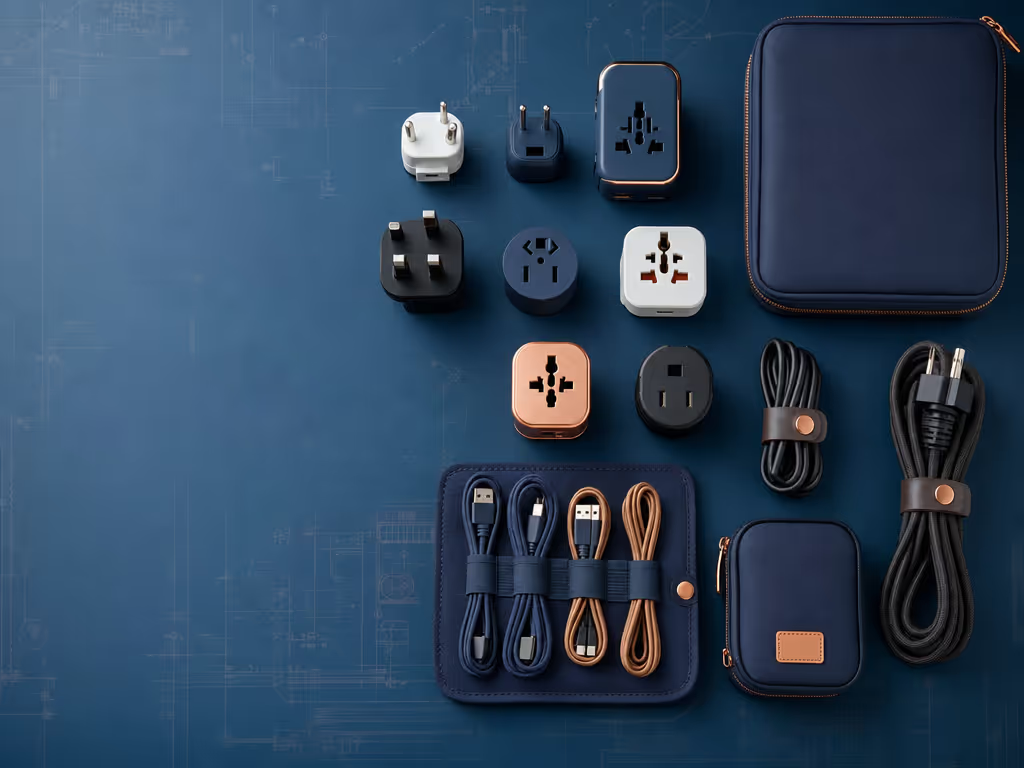
This is the most important travel check. A plug adapter changes the physical fit between your plug and a wall outlet. It does not change voltage.
General international travel voltage guidance indicates that a device marked "Input: 100-240V, 50/60Hz" will usually need the correct plug adapter rather than a voltage converter. But read the rating label on the exact kettle and consult its manual. A seller's "dual-voltage" claim is insufficient when the input range, frequency compatibility, and any voltage-selection procedure are not documented.
Before departure, verify:
- Input voltage range - Look for the full printed range, not just "dual voltage."
- Frequency rating - Confirm the label includes the destination's supply frequency where relevant.
- Plug and adapter - Match the adapter to the outlet type; remember it does not convert power.
- Wattage - Know the kettle's listed wattage and make sure the intended outlet setup is appropriate for a high-power heating appliance.
- Manual instructions - Follow the manufacturer's stated use conditions, fill limits, and warnings.
A mismatch between appliance input and destination power is not a minor inconvenience. High-power heating appliances, including travel kettles, need particular care when their input voltage does not match destination power.
How fast will a small travel kettle boil water?
There is no verified boil-time test for a collapsible silicone travel kettle in the available evidence. Do not translate an 850 W retailer claim into a promised heating time.
As an illustration of why conditions matter, an independently tested, non-folding small kettle drew 960 W and boiled 1.25 cups in 2 minutes 10 seconds and 2 cups in 3 minutes 5 seconds. That test took place at 6,970 feet, where the tester reported a local boiling point of 199°F, using water that began at 56–61°F. Larger tested volumes took longer.
The useful conclusion is methodological, not predictive: fill volume affects heat-up time, but so do wattage, elevation, starting-water temperature, heating control, and kettle design. Travel brewers should heat only the water required for the recipe when the manual permits it, following these energy-saving water-use practices, and should not assume performance from a different kettle translates to a foldable one.
What are the real downsides and safety checks?
The downsides are mostly about uncertainty and operating conditions rather than portability itself.
Safety is model-specific
The U.S. Consumer Product Safety Commission issued a June 11, 2026 warning covering specified Sekaer portable stainless-steel kettles (models SY-618, SKE-833, SKE-840, and SKE-850). The agency said those models could pressurize and release hot steam or liquid unexpectedly. It cited 116 reports and 89 injuries, including second- and third-degree burns.
This warning does not establish a defect in silicone kettles or collapsible designs. The model-specific warning shows why checking current safety notices for the exact model matters. Check the travel kettle safety guide and current safety notices for the exact model, use the appliance only as directed, keep your hands away from the steam path, and do not operate it where a spill would injure someone or damage electronics.
Precision claims need verification
No independent evidence here establishes that foldable travel kettles meet a particular temperature tolerance, offer dependable keep-warm behavior, or pour cleanly without dripback. If those are deal-breakers, ask for the manual and test the unit under your own workflow before relying on it for a trip.
A plain technical diagram of the desired workflow would show three separate checkpoints: wall outlet → kettle rating label → measured water delivery. Each link has to agree. A compatible plug cannot compensate for the wrong voltage, and a boiling kettle cannot compensate for uncontrolled flow.
FAQ
Are travel kettles worth buying?
Consider a foldable model only if its compact form factor matches your packing needs and you can verify the exact model's electrical rating and operating instructions. They are a weaker choice when you require proven temperature precision, tested pour control, or documented long-term durability; those characteristics are not established for the foldable silicone category by the evidence available here.
How much is a foldable kettle?
One unbranded collapsible listing displayed a price of US$62.77 when checked. Treat that as one seller's time-sensitive price, not a normal market price or a category benchmark.
Can I use a food grade silicone kettle abroad with only an adapter?
Only if the specific kettle's rating label supports the destination voltage and frequency. A kettle marked 100-240V, 50/60Hz will usually need the appropriate plug adapter, but confirm the exact label and manual first. An adapter alone does not convert voltage.
Summary and final verdict
One unbranded seller markets a collapsible silicone kettle as portable. That is an advertised attribute of that listing, not a category-wide finding. Capacity, protective features, durability, flavor neutrality, temperature accuracy, and pouring behavior remain product-by-product questions.
Final verdict: consider a foldable kettle only after verifying its complete electrical rating, manual, and current safety status. For pour-over coffee or temperature-sensitive tea, do not let the folded footprint stand in for performance data. Flow before foam, and voltage before packing.
Related Articles