360 Swivel Base Kettles: Everyday Ergonomics and Durability
By Sasha Petrovic • 25th Sep
Quick answer
A retailer listing for the BLACK+DECKER JC70-B5 says its 360° swivel base allows placement from any angle, but that claim does not prove ergonomic, safety, or durability benefits on its own. Judge the complete workflow: filling, lifting, gripping, pouring, docking, and cleaning.
- Short answer: For the BLACK+DECKER JC70-B5, the retailer describes any-angle placement as a convenience feature. It remains a product-specific marketing claim rather than a guaranteed performance improvement.
- Key distinction: Handle access, balance, spout control, lid opening, and cleaning access matter more to daily usability than the 360° label. Independent findings on these features are model-specific.
- Important caveat: There is no collected evidence measuring swivel-connector wear or proving longer service life. Keep the base and connector dry, use only the supplied base, follow the model’s filling instructions, and consider warranty coverage.
A 360 swivel base kettle may be marketed as a convenience upgrade, but cordless kettle ergonomics depend on more than the base feature. The useful question is narrower: does the detachable-base workflow make your actual sequence (fill, heat, lift, pour, return, clean) more controlled and less awkward? The available evidence supports evaluating that workflow, especially the handle, spout, lid opening, and care requirements. It does not prove that every 360° base is inherently more ergonomic or more durable than another base design.
That distinction matters. For tea, look for a clean, predictable pour. For manual coffee, assess whether a gooseneck model gives you control of stream speed and direction.
FAQ: What does a 360° swivel base actually do?
The Dash DEK001 manual directs users to lift the kettle from its power base and tilt it to pour. For the BLACK+DECKER JC70-B5, a retailer listing says its 360° swivel base allows the kettle to be placed back on the base from any angle.
That is a product-specific marketing claim, not a verified performance guarantee. The practical benefit is simply worth testing in your own counter layout: For readers with limited hand mobility, compare these details with an ergonomic kettle guide for arthritis and accessibility, which focuses on handle design, grip effort, and no-lift operation.
- Can you return the kettle to its base without rotating your body or moving other appliances?
- Is the cord routed away from the sink edge, burner, and your pouring path?
- Does the vessel settle securely when you set it down naturally?
- Can both the usual user and an occasional user grasp the handle without searching for its orientation?
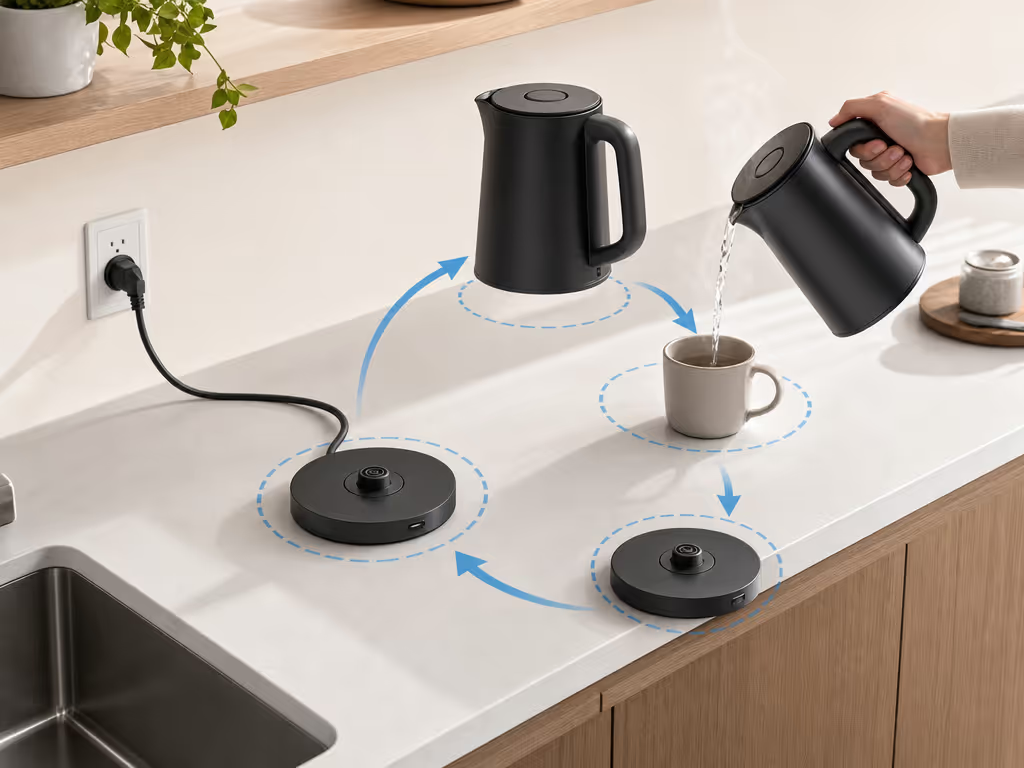
Think of the setup as a simple station: wall outlet → base and cord → lift zone → cup or brewer → return zone.
FAQ: Are cordless kettles any good for everyday use?
They can be useful when the detachable workflow fits the way you serve water. Two product manuals illustrate that workflow: the Dash DEK001 manual directs users to lift the vessel from its power base to pour, while the SWK 2300BK manual directs users to remove the kettle from its base before filling. That arrangement can keep the powered base on the counter while the kettle moves to the cup, teapot, or brewer.
The limitation is equally important: "cordless" describes the kettle in your hand, not every detail of the system. For the Dash DEK001, the manual refers to a power base and cord and directs users to ensure both are dry before use. Its placement is part of the ergonomics. A cord management kettle solution is therefore not a special kettle category; it is a layout decision. Leave enough slack to place the base where you can reach it, but not so much that the cord lies in the wet or active part of the counter.
For a shared kitchen, evaluate the whole cycle rather than the sales label. If the lid is awkward, the handle forces an uncomfortable grip, or the spout dribbles, the convenience of a detachable base will be marginal.
Repeatability is a precondition, not an optional refinement when hot water is moving around a busy counter.
FAQ: Which ergonomic features matter more than the swivel action?
Independent kettle testing has focused on criteria that map directly to daily use: pouring cleanly into a mug without splashing or dribbling; controlling stream speed and direction with gooseneck models; handle safety and access; lid access; and cleaning access. Those are stronger decision points than a 360° label alone.
1. Handle clearance and balance
Assess the handle with the kettle at a realistic fill level, not empty on a store shelf. You want enough clearance for your fingers, a grip that does not force your knuckles toward the hot body, and a wrist position that remains stable while tipping.
Open-bottom handle designs can be easier to access than fully enclosed handles on particular models, and wide handles have tested comfortably on particular models. Those findings are useful prompts, not universal rules. Hand size, grip strength, and the kettle's balance still vary.
2. A controlled, clean spout
A basic kettle should use a spout design tested for clean pouring to pour into a mug without splashing or dribbling. For pour-over, assess whether you can direct the stream and modulate its speed without abrupt surges. Do not assume a glass electric kettle, metal kettle, or any other body material predicts pouring quality; the relevant geometry is the spout-and-handle system.
My own reminder came in a crowded cupping lab: identical brews began to drift while bloom mass and timing looked correct. The eventual culprit was a burr inside a gooseneck. The lesson applies here: inspect the part that governs water motion, not only the headline feature.
3. Lid opening and interior reach
A large opening can make it easier to reach inside for kettle cleaning and descaling; that was a positive finding for one tested model. Before buying, look past whether the lid is attractive or flips open quickly. Ask whether you can see mineral buildup, reach the interior, and rinse without trapping water around the lid area.
FAQ: Does a swivel base improve kettle connector durability?
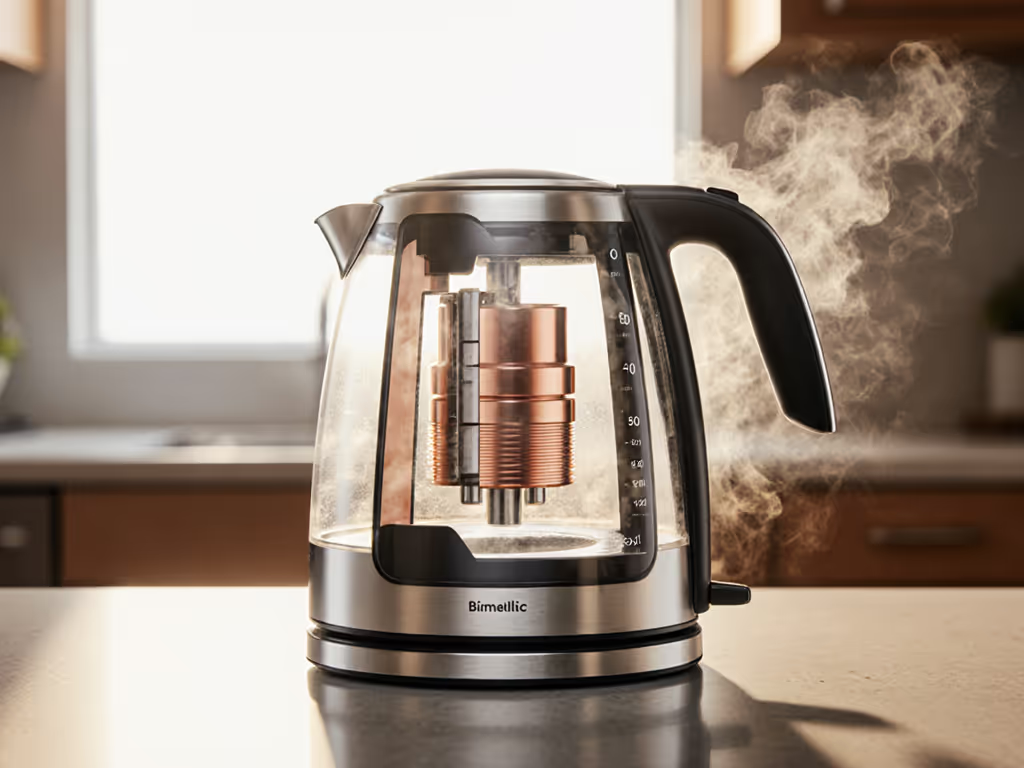
There is no collected connector-wear testing that supports that conclusion. No broad evidence here establishes how swivel-base contacts are engineered, whether rotation changes wear, or how repeated docking affects service life. Treat kettle connector durability as an open question that requires model-specific evidence, not a benefit you can infer from "360°". For a closer look at the mechanical weak points, see this cordless base connector reliability testing, including simulated lift-cycle wear and electrical contact performance.
What you can do is follow the applicable manual. The Dash DEK001 manual directs users to ensure the kettle, power base, and cord are dry before each use. The SWK 2300BK manual cautions against spilling water onto the connector while placing the vessel on or removing it from its base, and says to use the kettle only with its supplied base.
These habits are mundane but material:
- Fill the kettle away from the base when its instructions require that sequence.
- Close the lid and observe the marked fill limits before heating.
- Dry the vessel bottom and the base area before docking if either has become wet.
- Avoid operating an empty kettle when the manufacturer warns against it.
- Remove limescale at intervals appropriate to your usage and water hardness when the manual calls for regular descaling.
Repeated boiling is demanding on electrical appliances generally, and independent buying guidance notes that electric-kettle failures can be common enough to make warranty coverage worth evaluating. That is not evidence against swivel bases specifically. It is a reason to read the warranty terms, retain proof of purchase, and prioritize designs you can clean properly.
FAQ: Does a detachable base help coffee and tea precision?
The available evidence does not compare detachable bases on temperature accuracy, temperature drift during a pour, or flow rate. Independent testing instead supports evaluating pouring control directly: basic kettles for clean pouring and gooseneck models for control of stream speed and direction.
For tea service, the practical aim is a clean, predictable transfer into the vessel. For coffee, use a simple repeatability check: fill to your normal brewing level, pour plain water for a fixed interval into a vessel on a scale, and repeat several times. Watch for pulsing, an unstable stream, late drips, or a handle angle that changes as the kettle empties. Use that check to assess stream speed and direction, which are criteria independent testing applies to gooseneck models.
FAQ: What should I inspect before choosing one?
Use this short, evidence-aligned checklist:
- Docking: Place and lift the kettle from the base several times in your intended counter position.
- Grip: Check finger clearance, wrist angle, and balance at a realistic water level.
- Pour: Look for a clean stream and control appropriate to mugs, tea service, or a brewer.
- Lid and cleaning: Confirm you can fill, inspect, and descale the interior without fighting a narrow opening.
- Base care: Read the instructions for keeping the connector dry and for the specified filling sequence.
- Ownership terms: Check warranty coverage, because a 360° claim alone says little about longevity.
Summary and Final Verdict
For the BLACK+DECKER JC70-B5, a retailer says the 360° swivel base allows the kettle to be returned to its powered base from any angle. That is a product-specific convenience claim, not proof of superior comfort, safety, or lifespan.
The better buying standard is observable: a handle you can use securely, a spout that pours cleanly, an opening you can clean, a base you can keep dry, and instructions you can follow without improvising. If those elements are right, the swivel base can be part of a controlled workflow. For another perspective, see this kettle base comparison. If they are wrong, 360 degrees will not rescue the experience.
Related Articles